Indigenous Data Alliance Recent Highlights |
|
Looking Ahead and Staying Grounded New industry standard calls for better record-keeping to protect Indigenous data, new policy brief on AI in agriculture, upcoming webinars, and early bird registration is open for the Summit 2026. |
|
The Institute of Electrical and Electronics Engineers recently approved the first-ever international standard regarding best practices for protecting Indigenous data |
“Provenance details the history of a particular set of data,” said Carroll. “It tells you where it originated from. It should also tell you how it’s moved over time and how it’s potentially changed over time.” Carroll said the publication of a standardized process for documenting the ownership record for Indigenous people’s data is a critical first step in ensuring scholars engage in ethical research. “Not only is such background information important for sharing the potential benefits of research with Indigenous communities,” Carroll said, “it’s also crucial to creating possibilities for Native communities to benefit from data and research relationships. |
|
|
|
|
Second Policy Brief on AI in Agriculture |
|
|
|
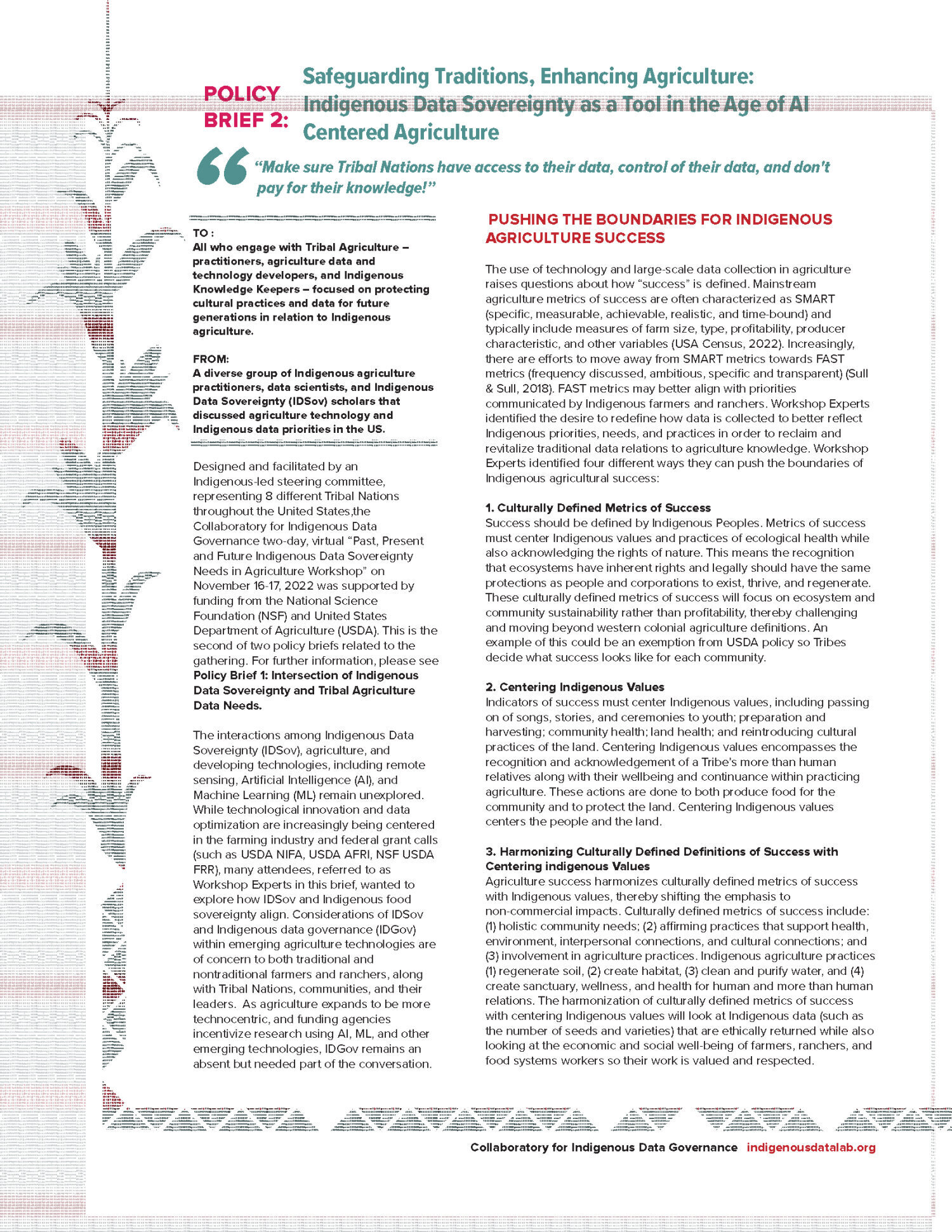
We are proud to share the second policy brief emerging from the Past, Present, and Future Indigenous Data Sovereignty Needs in Agriculture Workshop. Led by Dr. Lydia Jennings (Pascua Yaqui Tribe) this workshop gathered Indigenous agriculture practitioners, data scientists, and IDSov scholars representing 8 Tribal Nations across the U.S.
The brief titled “Safeguarding Traditions, Enhancing Agriculture: Indigenous Data Sovereignty as a Tool in the Age of AI Centered Agriculture” examines how interactions among Indigenous Data Sovereignty (IDSov), Indigenous agriculture, and developing technologies like remote sensing, AI, and Machine Learning remain unexplored. As technological innovation and data optimization rise across agriculture and federal funding calls, Workshop Experts highlighted the need to explore how IDSov aligns with Indigenous food sovereignty.
Considerations of IDSov and Indigenous data governance (IDGov) are essential for traditional and nontraditional farmers, Tribal Nations, communities, and leaders. Yet as agriculture becomes more technocentric and funding agencies incentivize AI- and ML-driven research, IDGov is missing but urgently needed in these conversations.
Read the new policy brief to learn how IDSov can help safeguard traditions and shape the future of AI-centered agriculture. |
|
|
|
Save the Date: Two Upcoming February Webinars |
|
Webinar 1: "It's Never Going To Be A Non-Issue”: AI And Indigenous Interests |
Feb 11, 2026 04:00 PM Eastern Time |
AI and Indigenous interests will never be a non-issue - Indigenous communities face ongoing threats to self-determination as data is extracted globally without consent, and participation in the AI landscape isn't optional. This webinar examines both the serious risks and strategic opportunities within this reality. Drawing on experience in tribal planning and ongoing independent monitoring of AI developments, we'll explore practical approaches Indigenous communities and institutions can take now: implementing safer data storage practices, developing offline models that maintain data sovereignty, and deploying specialized smaller language models built on clean, community-controlled datasets. Participants will learn methods for monitoring AI developments and receive actionable recommendations for making strategic choices that center Indigenous rights while navigating an AI landscape that won't wait for permission. |
|
|
Webinar 2: The World's First Indigenous Data Standard: IEEE 2890-2025 Provenance of Indigenous Peoples’ Data |
Feb 18, 2026 02:00 PM Arizona |
Join Stephanie Carroll, Jane Anderson, Randy Akee, Camille Callison, Maui Hudson, and Max Liboiron to discuss the development, approval, and public access to the IEEE 2890-2025 Recommended Practice for Provenance of Indigenous Peoples’ Data. The IEEE 2890-2025 Recommended Practice for the Provenance of Indigenous Peoples’ Data details the process for describing and recording the provenance of data about or related to Indigenous Peoples and their cultures, lands, and knowledge systems. Within data-generated industries, such as artificial intelligence and machine learning, as well as biodiversity research and innovations in genomic science, this standard enhances the integrity of that data, and the likelihood of engaged collaborations with data producers in ways that were previously unthinkable. Setting standards begins to address the combined problems of the proliferation of unreliable data and information on Indigenous Peoples; the lack of Indigenous participation, control, and governance over the circulation of Indigenous data and information; and the misappropriation and misuse of Indigenous data and information. This webinar will describe the context for and development of the standard, and its implications for Indigenous Peoples and other data actors. Notably, the process included Indigenous leadership at all stages, an Indigenous Caucus, consultation with Indigenous Peoples, and ensuring open access for the standard. |
|
|
|
|
|
Early Bird Registration Open for Summit 2026 |
Coming Home: Indigenous Data Governance By Us For Us |
The next U.S. Indigenous Data Sovereignty & Governance Summit is happening in Tucson, AZ, on April 15-17, 2026. Attendee early bird registration ends February 15! Don't forget to save the date, and register today.
Due to the abstract submission deadline extension, notification will now occur by February 1, 2026, and selected abstracts will receive codes to register at the early bird rate through February 28.
|
|
|
|
|
APRIL 14, 2026 | TUCSON, AZ |
The Masterclass sessions are designed to be lively and interactive with plenty of opportunities for small-group discussion. For this reason, the Masterclass will be capped at 100 people and available to Summit participants on a first-come basis. |
|
|
|
|
Join us in furthering the movement and strengthening our impact: |
As a Summit Sponsor you become a key supporter of our collective efforts on Indigenous data governance and enhancing Indigenous Peoples’ laws, policies, and systems for our shared data futures. |
|
|
|
|
|
|
|