|
|
Advanced Airway Management |
|
|
Advanced airway management (AAM) in prehospital and emergency settings includes several techniques designed to secure a patient's breathing, primarily endotracheal intubation (ETI), supraglottic airways (SGA), and cricothyroidotomy.1-5 These interventions are critical in treating patients with cardiac arrest, trauma, and medical emergencies; though success rates and device choices vary based on the specific clinical scenario, clinician proficiency, and clinical practice act.1 Supraglottic airways or blindly inserted advanced airways (e.g., Combitubes, King Airways (KA), i-Gels, and Laryngeal Mask Airways) are considered basic life support interventions and may be permitted for use by athletic trainers under standard emergency protocols, provided the athletic trainer has documented proof of competency; although it could vary by individual state practice acts.3,5,6 Endotracheal intubation and cricothyroidotomy are advanced life support airway interventions that may be performed only by appropriately trained and authorized clinicians, such as physicians and paramedics, depending on jurisdictional scope of practice.1-4 Additional research is needed to better define the role of advanced airway management within athletic training practice and education.
It is important to note that nasopharyngeal airways (NPAs) and oropharyngeal airways (OPAs) are basic airway adjuncts designed to help maintain airway patency. They are not considered advanced airway management devices, and may also be used by athletic trainers intervening in an emergency.5 |
|
The helmet chinstrap inhibits quality ventilation (rate and volume) in airway procedures which require the seal of a mask with the face. However, the KA which is supraglottic, will allow quality ventilation of patients with a helmet on and chinstrap fastened. If a supraglottic airway is not available, the helmet may need to be removed to provide quality ventilations.5,7 |

|
“Advanced Airway Management Success Rates in a National Cohort of Emergency Medical Services Agencies” Nwanne et al. (2020). The authors analyzed 57,209 advanced airway management encounters across a national cohort of 552 EMS agencies to evaluate procedural success. The data showed that conventional endotracheal intubation (cETI) had a success rate of only 76.9%. Supraglottic airways demonstrated higher effectiveness, with a 90.1% success rate for initial use and 87.3% for rescue attempts following a failed intubation. Clinical Take-Home Message: SGAs are associated with much higher procedural success than conventional intubation techniques, particularly in medical non-arrest and trauma populations. Guidelines offer expert-consensus recommendations for managing airways in adult patients with suspected or confirmed cervical spine (C-spine) injuries. The authors recommend prioritizing the jaw thrust maneuver over the head-tilt plus chin-lift to minimize vertebral movement during ventilation. Clinical Take-Home Message: Clinicians should utilize videolaryngoscopy and jaw-thrust maneuvers to limit C-spine movement, while maintaining a low threshold for removing immobilization equipment if an intubation attempt becomes difficult. National guideline based on a systematic review of prehospital airway management for adults and children. The panel identifies mastered bag-valve-mask (BVM) ventilation as the foundational skill for all emergency airway care. The guideline suggests that SGA should be used as the primary invasive modality in systems that do not demonstrate high ETI proficiency. Clinical Take-Home Message: Emergency providers should prioritize high-quality BVM ventilation and SGAs as the primary advanced airway strategies unless they can prove and maintain high first-pass success rates for ETI.
Cross-sectional study of 350,216 patients evaluated how shifts in EMS agency airway strategies (intubation vs. SGA) impacted out-of-hospital cardiac arrest outcomes. The study observed a national trend of increasing SGA use, which rose from 65 agencies in 2016 to 113 in 2022. While overall survival rates declined after 2019, lower-performing agencies that transitioned from intubation to SGA saw a relative improvement in outcomes, including higher rates of return of spontaneous circulation (ROSC) and survival. The results suggest that the simplicity of SGA insertion may mitigate the adverse survival impacts observed during the COVID-19 pandemic period. Clinical Take-Home Message: For lower-performing EMS agencies, transitioning from a primary intubation strategy to a primary SGA strategy is associated with improved survival and ROSC rates. |

|
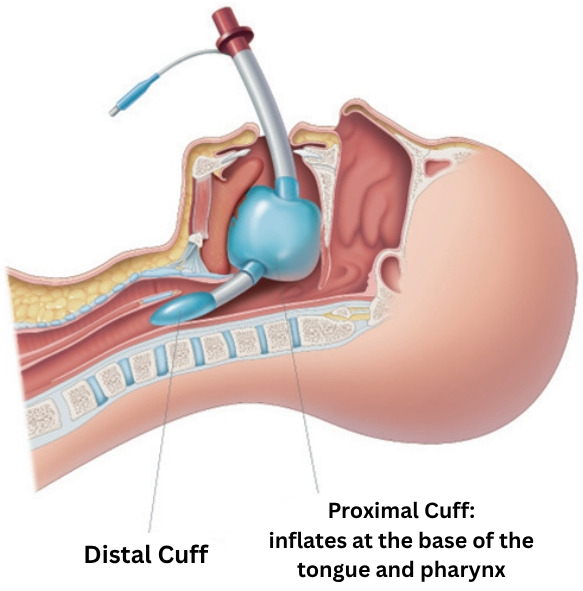
|
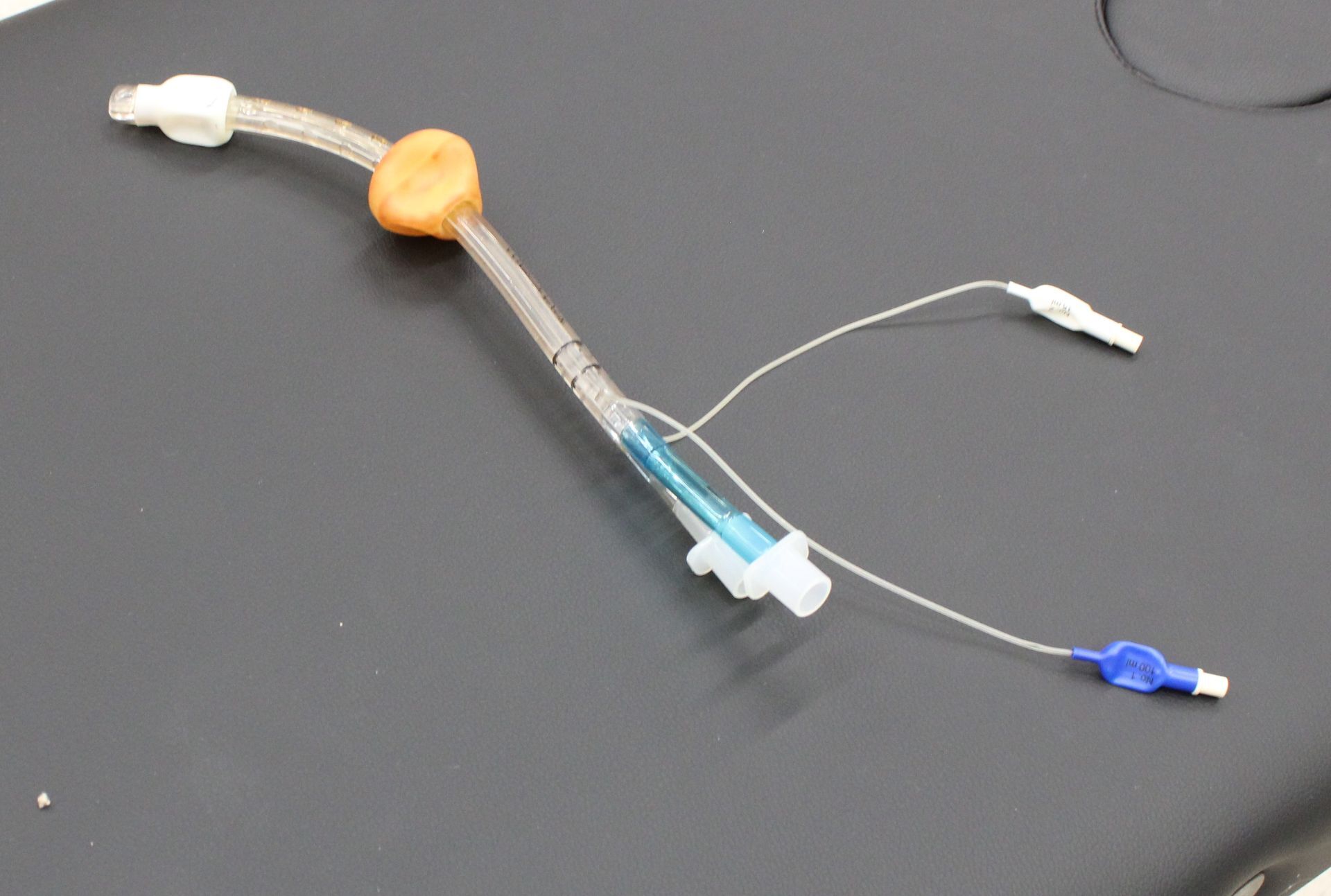
This image shows an Esophageal-Tracheal Combitube, a specialized dual-lumen supraglottic airway device commonly used in emergency medicine and pre-hospital care for rapid airway management. Photo courtesy of Brian Newman, PhD, ATC, LAT. |
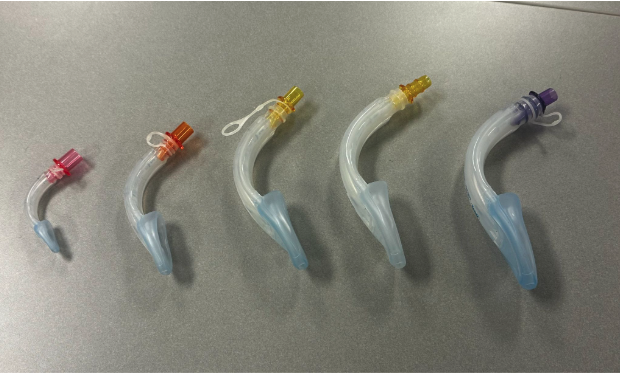
The image displays a line-up of size-graduated air-Q intubating laryngeal airway (ILA) devices (supraglottic airway devices) featuring curved tubes and anatomically shaped masks with different color-coded connector rings indicating varying sizes for patients ranging from neonates to adults. Photo courtesy of Brian Newman, PhD, ATC, LAT. |
|
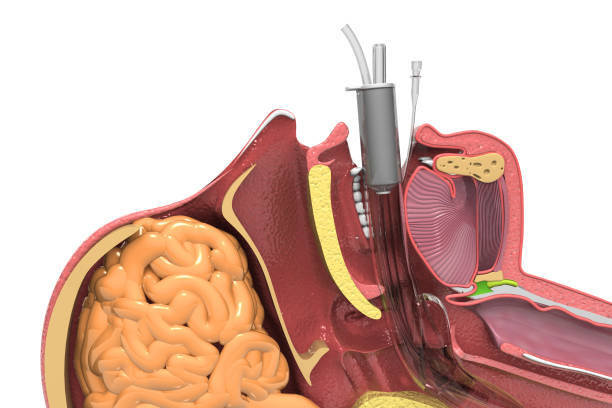
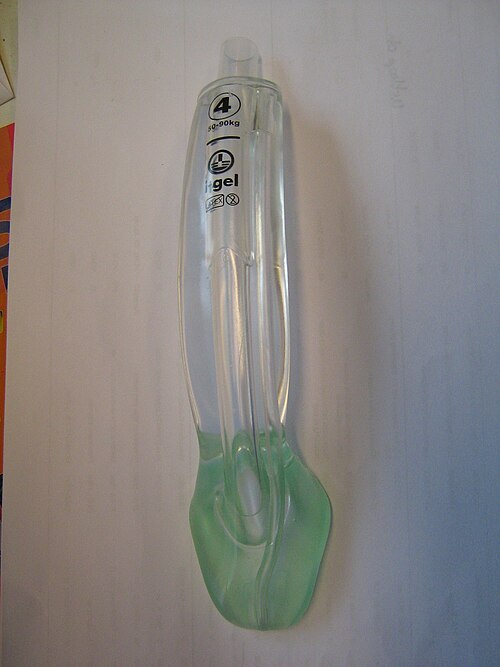
The device shown in the image is an i-gel Supraglottic Airway (specifically Size 4 for medium adults), manufactured by Intersurgical. It is a second-generation supraglottic airway device widely used in emergency medicine, resuscitation, and anesthesia.Unlike traditional laryngeal masks, the i-gel features a non-inflatable cuff made of a soft, medical-grade thermoplastic elastomer. This design allows it to naturally mirror and conform to the patient's anatomy, creating an efficient anatomical seal over the laryngeal inlet without the risk of tissue compression trauma from an over-inflated balloon. Image reproduced from https://commons.wikimedia.org/wiki/File:Airway.larynxmasker.laryngeal.mask.gelei.JPG. |
|
References in introduction 1. Nwanne T, Jarvis J, Barton D, Donnelly JP, Wang HE. Advanced airway management success rates in a national cohort of emergency medical services agencies. Resuscitation. 2020;146:43-49. doi:10.1016/j.resuscitation.2019.11.006 2. Jarvis JL, Panchal AR, Lyng JW, et al. Evidence-Based Guideline for Prehospital Airway Management. Prehosp Emerg Care. 2024;28(4):545-557. doi:10.1080/10903127.2023.2281363 3. Nassal MMJ, Yang BY, Hall J, et al. Advanced Airway Practice Patterns and Out-of-Hospital Cardiac Arrest Outcomes. JAMA Netw Open. 2025;8(9):e2532334. Published 2025 Sep 2. doi:10.1001/jamanetworkopen.2025.32334 4. Wiles MD, Iliff HA, Brooks K, et al. Airway management in patients with suspected or confirmed cervical spine injury: Guidelines from the Difficult Airway Society (DAS), Association of Anaesthetists (AoA), British Society of Orthopaedic Anaesthetists (BSOA), Intensive Care Society (ICS), Neuro Anaesthesia and Critical Care Society (NACCS), Faculty of Prehospital Care and Royal College of Emergency Medicine (RCEM). Anaesthesia. 2024;79(8):856-868. doi:10.1111/anae.16290 5. Bowman TG, Boergers RJ, Lininger MR. Airway Management in Athletes Wearing Lacrosse Equipment. J Athl Train. 2018 Mar;53(3):240-248. doi: 10.4085/1062-6050-4-17. Epub 2018 Feb 8. PMID: 29420059; PMCID: PMC5894374. 6. Scarneo-Miller SE, Hosokawa Y, Drezner JA, et al. National Athletic Trainers’ Association Position Statement: Emergency Action Plan Development and Implementation in Sport. Journal of Athletic Training. 2024 May;59(6):570–583. doi:10.4085/1062-6050-0521.23 7. Bowman TG, Boergers RJ, Caswell SV, et al. Prehospital care of suspected spine-injured lacrosse athletes: a systematic search, evidence review, and consensus recommendations. Br J Sports Med. 2025;59(9):630-639. Published 2025 Apr 24. doi:10.1136/bjsports-2024-108951 |
|
This content was developed in part by Richard J. Boergers, PhD, ATC; Leslie Rippon PhD, ATC; and the NATA Foundation Educational Resources Committee. |
|
View all past Research to Clinical Practice issues HERE. |
|
|
|
|