Asters once symbolized revolution. They were used to honor soldiers lost in war. Also, they served as inspiration for painters and writers.
The Aster
A member of the daisy family (Asteraceae family), which also includes dahlias, marigolds, and sunflowers, asters provide a pop of color as summer turns to fall.
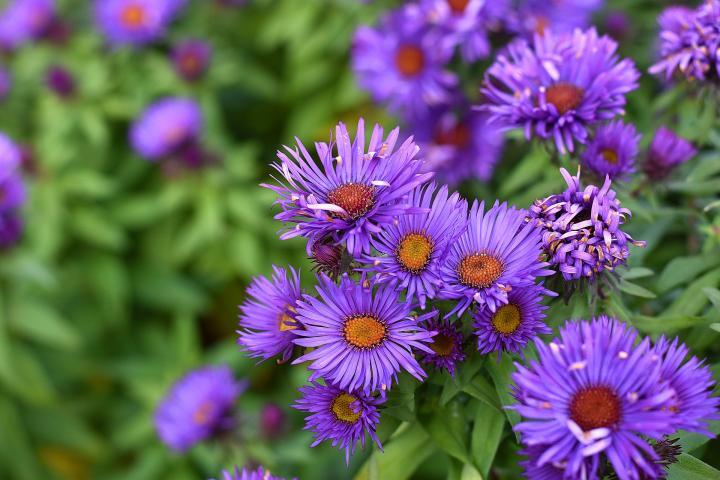
There are hundreds of asters—with estimates between 250 and 350 species—growing around the world. The daisy-like flowers, which come in colors ranging from white and yellow to pink, purple, red, and blue, have thin petals radiating from a white or yellow tubular disc floret (white or yellow centers).
Recently, the Aster genus was refined and split up, resulting in almost all of the common North American “asters” being reclassified under a new genus, Symphyotrichum. Asters true to the Aster genus are now almost exclusively native to Europe and Asia.
Aster Meanings and Symbolism
In Greek, aster means “star,” which is a reference to the starlike appearance of the plant’s flowers.
In ancient Greek and Roman cultures, the burning of aster leaves was believed to scare away snakes and ward off evil spirits.
They were considered sacred flowers to the Greek and Roman gods. Greek mythology pinpoints the aster’s beginning from the tears of the goddess Astraea.
Asters have long been a symbol of love, wisdom, patience, and beauty. The aster has also been associated with faith, friendship, and purity.
Purple asters are considered a royal color and a symbol of wisdom; white asters represent innocence; red is a sign of devotion and passion; and pink symbolizes love and kindness.
Some consider asters to be the zodiac flower for Capricorns.
The flower is given on 20th wedding anniversaries.
The Aster in History
The stately looking aster is beloved in gardens and homes. Thomas Jefferson enjoyed the China aster (Callistephus chinensis) in particular, growing it on his Monticello estate. The aster has also been the subject of many great works of art, including those by Claude Monet and Vincent van Gogh. Poet Robert Frost used the aster flower as a symbol of hope in his poem, “A Late Walk.”
The aster has also been involved in cultural movements. A revolution in Hungary in the aftermath of World War I came to be known as the Aster Revolution, during which supporters of the revolution wore asters in their hats and demonstrated in the streets of Budapest. During World War II, asters were placed ceremonially on the tombs of French soldiers.
The aster plant has been used for various medicinal purposes over the years too. A tincture made from New England asters (Symphyotrichum novae-angliae) was thought to help with respiratory issues. It was once used to help decrease headache pain and hangovers and as a treatment for epilepsy.
Asters in the Garden
Asters are easy to grow and require very little attention. They bloom in late summer and early fall, just when the final bit of summer color begins to fade away. Plus, with its late-season blooms, the aster provides nectar and a place of rest for migrating butterflies.
Aster plants tend to grow in a bushy habit and can range from 6 inches up to 8 feet tall. Depending on the variety, some asters can tolerate full sun, while others prefer partial shade. In terms of soil, asters grow best in soil that is rich, loamy, and well-draining, although they will tolerate poorer soils too. Plants can be grown by seed, root, or stem cutting.
Both the leaves and flowers are edible, while many parts of the plant are used in teas and tinctures.